
PDF Ebook How Judges Think, by Richard A. Posner
Today book How Judges Think, By Richard A. Posner we offer right here is not sort of typical book. You understand, reviewing now doesn't imply to handle the printed book How Judges Think, By Richard A. Posner in your hand. You could obtain the soft data of How Judges Think, By Richard A. Posner in your gadget. Well, we mean that the book that we extend is the soft file of the book How Judges Think, By Richard A. Posner The material and all points are same. The distinction is just the forms of guide How Judges Think, By Richard A. Posner, whereas, this condition will specifically pay.
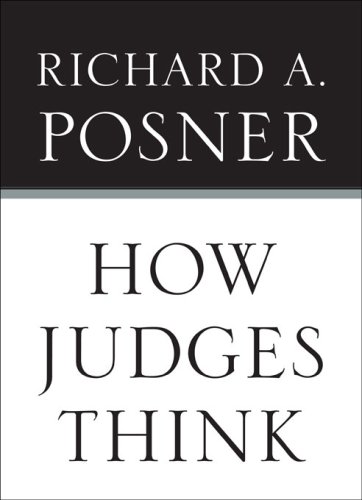
How Judges Think, by Richard A. Posner

PDF Ebook How Judges Think, by Richard A. Posner
How Judges Think, By Richard A. Posner. It is the time to improve as well as refresh your skill, understanding and also encounter consisted of some home entertainment for you after long period of time with monotone things. Working in the office, visiting study, learning from examination and more tasks could be completed and you should start brand-new things. If you feel so worn down, why do not you attempt brand-new point? A very simple thing? Reviewing How Judges Think, By Richard A. Posner is exactly what we offer to you will certainly know. And also the book with the title How Judges Think, By Richard A. Posner is the referral currently.
The reason of why you could obtain and also get this How Judges Think, By Richard A. Posner earlier is that this is the book in soft file type. You could check out the books How Judges Think, By Richard A. Posner anywhere you really want also you are in the bus, office, home, and other areas. Yet, you might not have to move or bring the book How Judges Think, By Richard A. Posner print anywhere you go. So, you will not have bigger bag to carry. This is why your selection to make far better principle of reading How Judges Think, By Richard A. Posner is actually handy from this situation.
Recognizing the method how to get this book How Judges Think, By Richard A. Posner is likewise useful. You have remained in ideal website to start getting this information. Get the How Judges Think, By Richard A. Posner link that we give here and also visit the web link. You can order guide How Judges Think, By Richard A. Posner or get it when possible. You could swiftly download this How Judges Think, By Richard A. Posner after getting bargain. So, when you need guide promptly, you can directly get it. It's so very easy therefore fats, isn't it? You must favor to in this manner.
Just link your tool computer system or gizmo to the web linking. Obtain the contemporary technology to make your downloading How Judges Think, By Richard A. Posner completed. Also you don't want to read, you could directly shut guide soft file and also open How Judges Think, By Richard A. Posner it later. You can also conveniently get guide all over, because How Judges Think, By Richard A. Posner it remains in your gadget. Or when being in the workplace, this How Judges Think, By Richard A. Posner is additionally recommended to review in your computer gadget.
A distinguished and experienced appellate court judge, Richard A. Posner offers in this new book a unique and, to orthodox legal thinkers, a startling perspective on how judges and justices decide cases. When conventional legal materials enable judges to ascertain the true facts of a case and apply clear pre-existing legal rules to them, Posner argues, they do so straightforwardly; that is the domain of legalist reasoning. However, in non-routine cases, the conventional materials run out and judges are on their own, navigating uncharted seas with equipment consisting of experience, emotions, and often unconscious beliefs. In doing so, they take on a legislative role, though one that is confined by internal and external constraints, such as professional ethics, opinions of respected colleagues, and limitations imposed by other branches of government on freewheeling judicial discretion. Occasional legislators, judges are motivated by political considerations in a broad and sometimes a narrow sense of that term. In that open area, most American judges are legal pragmatists. Legal pragmatism is forward-looking and policy-based. It focuses on the consequences of a decision in both the short and the long term, rather than on its antecedent logic. Legal pragmatism so understood is really just a form of ordinary practical reasoning, rather than some special kind of legal reasoning.
Supreme Court justices are uniquely free from the constraints on ordinary judges and uniquely tempted to engage in legislative forms of adjudication. More than any other court, the Supreme Court is best understood as a political court.
- Sales Rank: #670681 in Books
- Published on: 2008-04-30
- Released on: 2008-04-30
- Original language: English
- Number of items: 1
- Dimensions: 9.25" h x .92" w x 6.00" l, 1.60 pounds
- Binding: Hardcover
- 400 pages
From Publishers Weekly
Posner is unique in the world of American jurisprudence, a highly regarded U.S. appellate judge and a prolific and controversial writer on legal philosophy (The Little Book of Plagiarism). Opinionated, sarcastic and argumentative as ever, Posner is happy to weigh in not only on how judges think, but how he thinks they should think. When sticking to explaining the nine intellectual approaches to judging that he identifies, and to the gap between legal academics and judges, and his well-formulated pragmatic approach to judging, Posner is insightful, accessible, often funny and a model of clarity. When he charges off into longstanding arguments with fellow legal theorists (liberal commentator Ronald Dworkin, for one) or examines doctrinal discrepancies in the opinions of Supreme Court justices, he writes for a far more limited audience. For the record, although Justice Scalia is a favorite target, none of the Supreme Court nine escapes Posner's lethally sharp pen. Posner's two major points—that to a great extent judges make decisions based not on theory but on who they are, their gender, education, class and experiences, and that the Supreme Court is a political court regardless of what theory of constitutional interpretation justices claim—are well worthwhile and deeply rooted in common sense and experience. (Apr.)
Copyright � Reed Business Information, a division of Reed Elsevier Inc. All rights reserved.
Review
Posner is unique in the world of American jurisprudence, a highly regarded U.S. appellate judge and a prolific and controversial writer on legal philosophy. Opinionated, sarcastic and argumentative as ever, Posner is happy to weigh in not only on how judges think, but how he thinks they should think. When sticking to explaining the nine intellectual approaches to judging that he identifies, and to the gap between legal academics and judges, and his well-formulated pragmatic approach to judging, Posner is insightful, accessible, often funny and a model of clarity. (Publishers Weekly 2008-02-11)
Posner's latest book, How Judges Think, is important, if only because it's Posner looking at his own profession from the inside. Two of the chapters, "Judges Are Not Law Professors" and "Is Pragmatic Adjudication Inescapable?," are worth the price of admission by themselves. The book can be read as one long screed against the jurisprudence of Supreme Court Justice Antonin Scalia, and stands as a refutation to those who believe the category of conservative can lazily be applied to a mind as independent as Posner's.
--Barry Gewen (New York Times online 2008-07-09)
A prolific and brilliant writer, Posner's How Judges Think is perhaps his most illuminating work for its profound, and sometimes polemical, insights into the judicial process...Judge Posner's examination of the issues is thorough, scholarly and riveting. He has written an important book--a must read not just for lawyers, but also for anyone who wants to understand how the inscrutable, and sometimes oracular, process of judging really works.
--James D. Zirin (Forbes.com 2010-06-08)
From the Back Cover
From the book: Ivan Karamazov said that if God does not exist everything is permitted, and traditional legal thinkers are likely to say that if legalism (legal formalism, orthodox legal reasoning, a "government of laws not men," the "rule of law" as celebrated in the loftiest "Law Day" rhetoric, and so forth) does not exist everything is permitted to judges--so watch out! Legalism does exist, and so not everything is permitted. But its kingdom has shrunk and greyed to the point where today it is largely limited to routine cases, and so a great deal is permitted to judges. Just how much is permitted and how they use their freedom are the principal concerns of this book. . . . I am struck by how unrealistic are the conceptions of the judge held by most people, including practicing lawyers and eminent law professors, who have never been judges--and even by some judges. This unrealism is due to a variety of things, including the different perspectives of the different branches of the legal profession--including also a certain want of imagination. It is also due to the fact that most judges are cagey, even coy, in discussing what they do. They tend to parrot an official line about the judicial process (how rule-bound it is), and often to believe it, though it does not describe their actual practices. This book parts the curtain a bit.
Most helpful customer reviews
1 of 1 people found the following review helpful.
EXCEPTIONALLY CLEAR THINKING ON AN IMPORTANT ISSUE
By David Keymer
Posner is pretty much the Go-To Guy in legal studies today. You may disagree with his conclusions but he won’t bore you (he’s a forceful writer), you won’t find it hard to follow him (he writes clearly), and you won’t wonder whether he has a hidden agenda (he is open and forthright in stating his sources, as well as any reservations he has about his own conclusions drawn from them). He’s academic (well documented and well reasoned) but not overly academic: his observations are always rooted in experience, for he is both an eminent teacher of jurisprudence at the University of Chicago and an acting federal circuit court judge, with years of practice on the bench. His books are not easy reads –he explores complicated issues and doesn’t simplify them—but you’ll never get lost in them, because he is an exceptionally articulate explainer. Years ago, when I was a history professor at a small women’s college in the east, I taught a course on historical method, and it was writers (thinkers) (scholars) like Posner I wanted to introduce to my students, not that he writes like historians do but that he writes forcefully, sparingly, lucidly and compellingly, and persuasion is just as important a part of any scholar’s business as explication.
This is the third book by Posner that I have read. All three books were good. Two –including this one—are superb, models of engaged scholarship. (If you haven’t read anything by him before, I recommend you start with Reflections on Judging, 2013.) Posner is It.
Arguing against legalism and various forms of moralism, Posner argues for a restrained pragmatic approach to the law, in line with his models on the bench, especially Holmes (“The life of the law has not been logic; it has been experience”), who accepted that the written law only went so far and that beyond that point, the prudent judge crossed from enforcing pre-existing, stringent rules to making new law. Law in action is imprecise but not amorphous. “In our system the law as it is enforced in courts is created by judges, using legal propositions as raw materials.” He does not argue that a judge can make any law he wants. Rather, he argues that in any but the most constrained case, the judge must choose among courses of action that are not automatically (because the law tells the judge exactly what to do) clean --or should I say clear? From this simple premise –that judges are de facto legislators—Posner moves to a critique of many, maybe most academic commentators on the law, and a scathing critique of what is taught in even the best law schools in our country. He has, is in other books, harsh words to say about Justice Scalia’s supposed originalism, which he finds inadequate and self-deceiving –even Scalia admitted that he moved beyond it at times.
If I were a lawyer, I would read this book NOW.
3 of 3 people found the following review helpful.
Excellent insights into judicial decision-making
By Kenneth L. Matheny
In this erudite and highly readable book, a distinguished judge and scholar provides the reader with remarkable insights into how judges think, or ought to think, when interpreting and creating the law. Judge Posner rejects sterile legalist theories in favor of a pragmatic approach to judicial decision-making, heavily influenced by economic theory. Drawing on insights from psychology, American legal history, and economics, Judge Posner argues persuasively that judges are not rule-bound adjudicating machines mechanically applying the law; rather judges creatively engage the real world by balancing competing interests, weighing consequences, and applying cost/benefit analyses when interpreting the law. In the process, judges, at least in the unique American judicial system, inevitably act as legislators and, yes, as human beings, they are influenced by life experiences, political beliefs, and psychological make-up. The result is a highly sophisticated and nuanced discussion of how judges think, or at least how they should think. This book is written in a lively style, with humor, wit, and a great deal of wisdom, including some very practical advice regarding how attorneys should frame their arguments when they appear in court. (Hint: instead of focusing on words; focus on the real world consequences of your arguments).
3 of 3 people found the following review helpful.
Nailed It
By Pragmatist
If you have been inside the world Judge Posner writes about, you will know how extraordinarily practical this book is. This is how judges think - not how they think they think. Legal decisions arise in real contexts and judges almost always react in part to that context. If they did not, then our law would be the same as it was in 1242. Posner illuminates the pragmatic truth clearly while providing ample theoretical background for the budding philosopher.
At a time when the merely thoughtless insist that the "law be applied as written" (how, exactly, does one apply the phrase "equal protection" as written and divorced from context?)this refreshing burst of candor and common sense presented by the greatest legal mind of the past 50 years is critically important reading.
How Judges Think, by Richard A. Posner PDF
How Judges Think, by Richard A. Posner EPub
How Judges Think, by Richard A. Posner Doc
How Judges Think, by Richard A. Posner iBooks
How Judges Think, by Richard A. Posner rtf
How Judges Think, by Richard A. Posner Mobipocket
How Judges Think, by Richard A. Posner Kindle
0 komentar:
Posting Komentar